


 BLOG
BLOG

Cybersecurity in Manufacturing: When Production Lines Cannot Stop, How Can OT Devices Be Discovered and Managed Without Disrupting Operations?
Manufacturing OT devices often run on legacy systems or proprietary platforms and may be subject to vendor restrictions, making it difficult or impossible to install agents. This article explains how Agentless NAC establishes device visibility and access control, while ITAM provides deeper insights into assets, vulnerabilities, and compliance status—enabling continuous governance without disrupting production.
October 20, 2026


The AI and Post-Quantum Era: Enterprise Cybersecurity Shifts from Attack Prevention to Trust Governance | UPAS
From managing AI agent identities and permissions to inventorying cryptographic assets for PQC readiness, enterprise cybersecurity is shifting from one-time protection to continuous trust governance. Learn how device visibility, NAC and ITAM, and continuous verification can establish a strong cybersecurity foundation for the AI and post-quantum era.
October 12, 2026

Out of Sight, Out of Control: The Most Overlooked Management Blind Spots in Corporate Networks
Guest devices, IoT and OT equipment, and devices without an agent can all create management blind spots within corporate networks. This article explains the importance of network visibility and how UPAS combines Agentless NAC with ITAM to improve device coverage and management efficiency—from device discovery and access control to IT asset management.
September 24, 2026
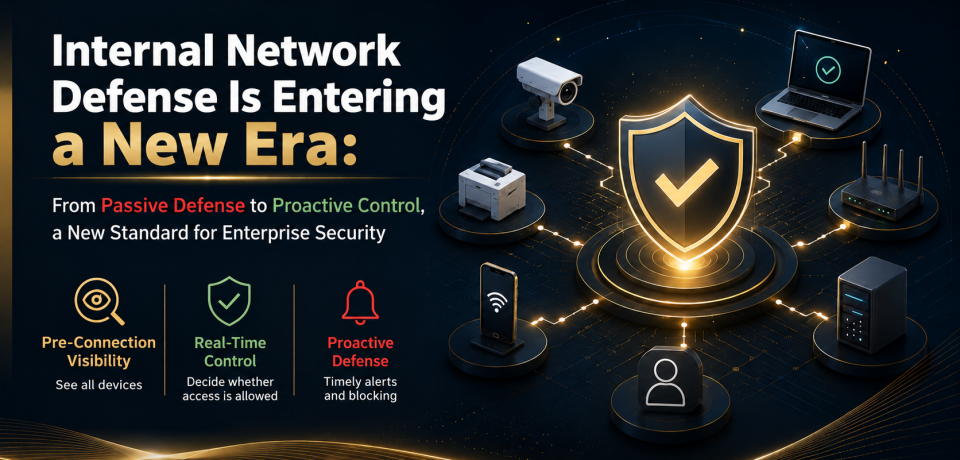
Internal Network Defense Is Entering a New Era: From Reactive Defense to Proactive Control—A New Standard for Enterprise Cybersecurity
Traditional defense helps enterprises record and analyze security events, but it can leave IT teams constantly handling exceptions and investigating issues after they occur. Drawing on common internal network management scenarios, this article explains how proactive defense uses earlier device identification, authorization checks, and access control to reduce the risk of threats spreading and ease the manual workload. It also shows how UPAS uses Agentless NAC to help enterprises establish an internal network security process covering device visibility, policy validation, and continuous governance.
August 28, 2026
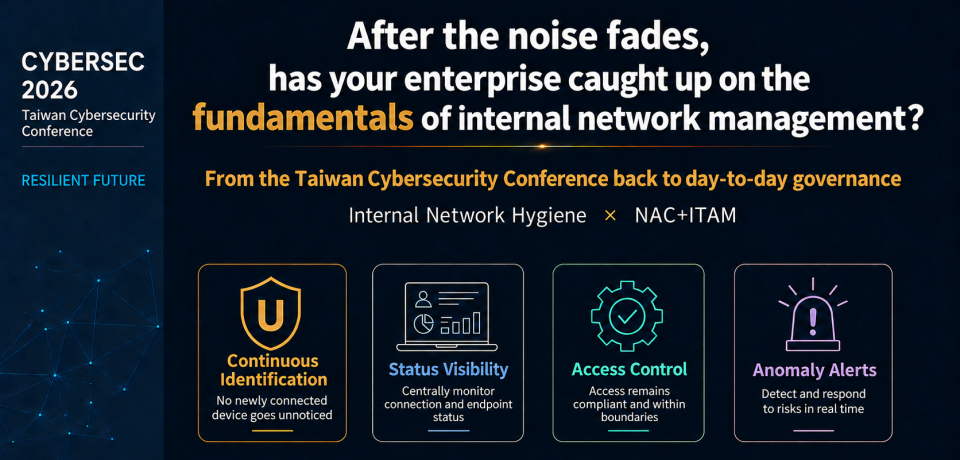
What CYBERSEC 2026 Reveals About Today’s Enterprise Environment: More Devices, Less Clarity in Internal Network Management
CYBERSEC 2026 was held from May 5 to 7 at Taipei Nangang Exhibition Center, Hall 2. Centered on the theme “RESILIENT FUTURE,” the event brought together more than 400 cybersecurity brands from Taiwan and around the world. From AI-powered defense, Zero Trust, and cloud security to the identification and protection of various connected devices across enterprise environments, the exhibition provided a comprehensive view of the technological directions shaping today’s cybersecurity market. Yet the more new technologies emerge, the more an enterprise’s ability to put them into practice depends on whether it has a clear grasp of its devices, identities, access privileges, and security posture.
August 07, 2026

From RSAC to Cybersec Asia: A Shared Cybersecurity Concern Across Four Major International Events in 2026—Hidden Blind Spots Within Enterprise Networks
In the first half of 2026, AI, automated defense, and Zero Trust remained key themes at RSAC in the United States, Cybersec Asia in Thailand, Japan IT Week, and CYBERSEC in Taiwan. Yet the question raised repeatedly was whether enterprises truly had visibility into every device on their internal networks. As printers, cameras, access control systems, guest devices, OT and IoMT equipment, and legacy systems continue to connect to corporate networks, even the most advanced defenses may rely on incomplete data without a trusted view of connected devices. Drawing on observations from these four events, this article explores how UPAS uses agentless NAC and ITAM to help enterprises discover devices, control network access, and establish continuous governance—creating internal network environments that are more transparent, controllable, and easier to operate and maintain.
July 17, 2026
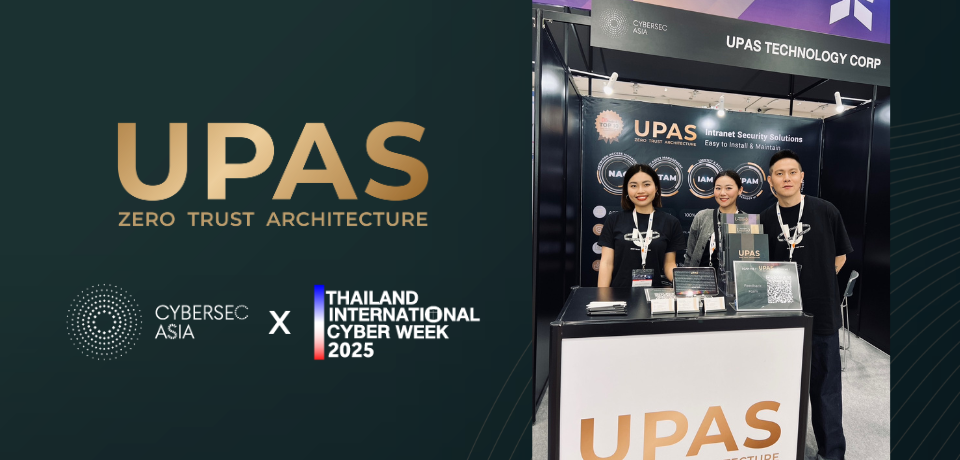
UPAS is checking in at Cybersec Asia 2025 in Thailand! 📍
From January 22 to 23, 2025, UPAS participated in Cybersec Asia in Thailand alongside the Taiwan External Trade Development Council (TAITRA). As an exhibiting brand in the Taiwan Pavilion, UPAS—which was honored as the Best Solution in Taiwan and the APAC Region by APAC CIO Outlook in 2023—is a Zero Trust security management brand featuring 100% in-house R&D and technical services from Taiwan.
February 05, 2025

How to comply with SEMI E187? The UPAS FAB Semiconductor Compliance Solution comprehensively boosts equipment security compliance rates across your fabs.
How to comply with SEMI E187? The UPAS FAB Semiconductor and Manufacturing Compliance Solution enhances facility equipment security, ensuring that every single device connecting to the internal network is safe and compliant.
September 04, 2024

Cybersecurity Summit Review: UPAS 3-Stage Integrated Zero Trust Solution! "Never Trust, Always Verify."
At the 10th anniversary of CYBERSEC 2024 in Taiwan, Zero Trust Architecture (ZTA) stands as today’s most critical cybersecurity topic. This year, UPAS’s core themes encompass ZTA Zero Trust Security Solutions, FAB Semiconductor Supply Chain Compliance Solutions, and SMB Lightweight Solutions. This article introduces the three stages of ZTA, along with UPAS ZTA Zero Trust solutions and modules, to build a secure, solid internal network defense for your organization.
June 03, 2024

UPAS is favored by international media and awarded 2 major honors: Pioneer in intranet security
UPAS wants to share a great news with everyone. We have been featured on the cover story of the American Silicon Valley Journal "APAC CIO Outlook"! At the same time, we were awarded "Top 5 Cyber Security Solutions Providers in Taiwan - 2023" and "Top 10 Cyber Security Solutions Providers in APAC - 2023" by the journal. Kun-Jung Lee, the founder and chairman of UPAS, was also interviewed by the magazine. He not only talked about UPAS’s prevention and control mechanism, but also mentioned UPAS’s expectations for cyber security and the company’s vision. The extensive report has greatly encouraged the UPAS team and has also made UPAS widely discussed in the industry.
August 22, 2023