


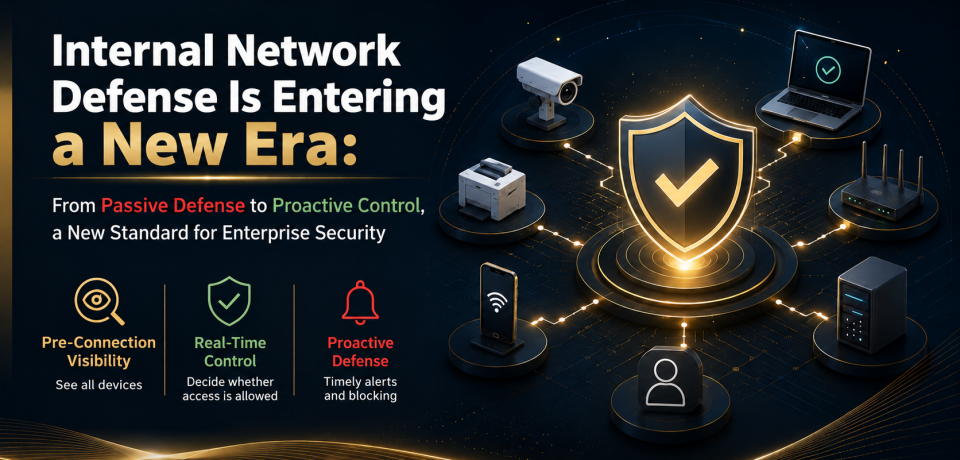
1. The Limits of Traditional Defense: Reactive Response Drains IT Teams
Discussions about enterprise cybersecurity often focus on major attacks, ransomware, or data breaches. For most IT administrators and operations teams, however, the greatest drain on time and energy is rarely a single major incident. It is the steady stream of everyday exceptions that may appear minor but never seem to end. These exceptions become a burden not only because of their volume, but also because enterprises often wait until a problem occurs before identifying the device, determining who is responsible, and updating policies. This leaves IT teams in a constantly reactive position.
An unfamiliar device suddenly appears on the internal network, an IP conflict occurs, a contractor needs temporary network access, or a computer has not completed an update. None of these situations may look like a crisis on its own, yet each one requires the IT team to investigate, verify, coordinate, document, and close the case. As an enterprise grows across more departments and manages a wider range of devices, these exceptions gradually build into a source of chronic fatigue.
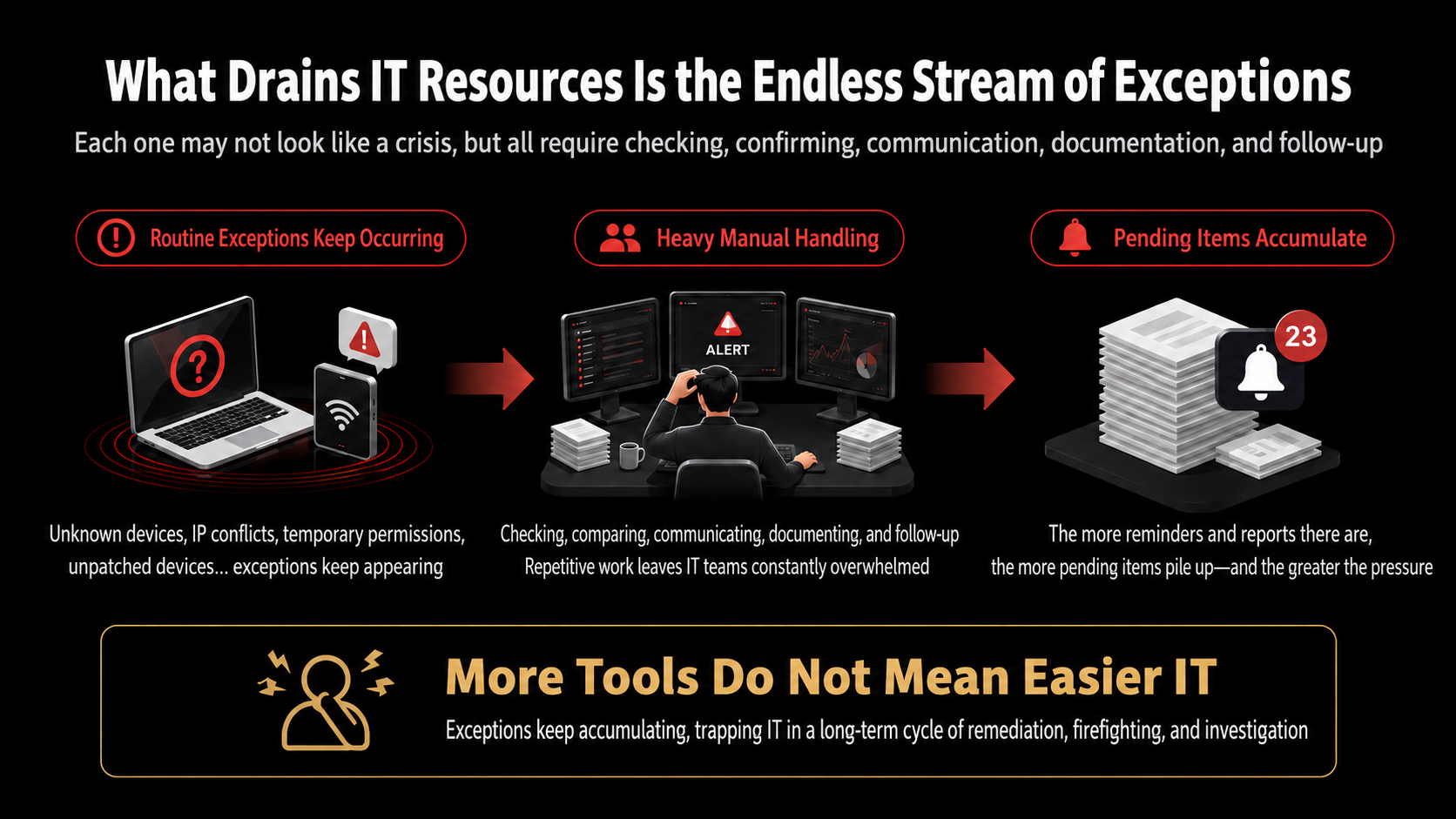
The reality is that adding more cybersecurity tools does not necessarily make IT teams' work easier. Tools can generate more signals, reports, and alerts, but if every alert requires manual review and every anomaly requires teams to compare multiple systems and follow up across departments, those tools may simply create more items for the team to handle.
This is a common limitation of traditional defense: it can help enterprises identify problems, but remediation often still depends on people responding after the fact.
For this reason, discussions about proactive defense must go beyond whether the technology is faster and consider the realities of day-to-day IT operations. When device connections, access approvals, anomalies, and ownership are not linked early in the process, frontline IT teams remain tied up with patching gaps, firefighting, and investigation. Proactive defense is intended to change this pattern of waiting until a problem occurs before taking action.
2. Traditional Defense Can Reveal Incidents but Struggles to Contain Their Spread
Traditional defense remains valuable. Enterprises need logs, alerts, incident tracking, and post-incident analysis to understand when an incident occurred, the scope of its impact, and its possible causes. This information is also essential for audits, incident investigations, and internal improvements.
Traditional defense, however, generally helps enterprises understand a problem only after it has already occurred. A device may already be connected to the internal network and anomalous activity may already have begun before the IT team starts investigating logs or alerts. As internal networks grow more complex, post-incident investigation alone is no longer sufficient for day-to-day defense.
For attackers and anomalous activity, this delay creates an opportunity. An unidentified device, temporary access that was not revoked in time, or a computer that has gone without updates may appear to be a minor gap under normal conditions. Once exploited, however, it can become a starting point for risk to spread.
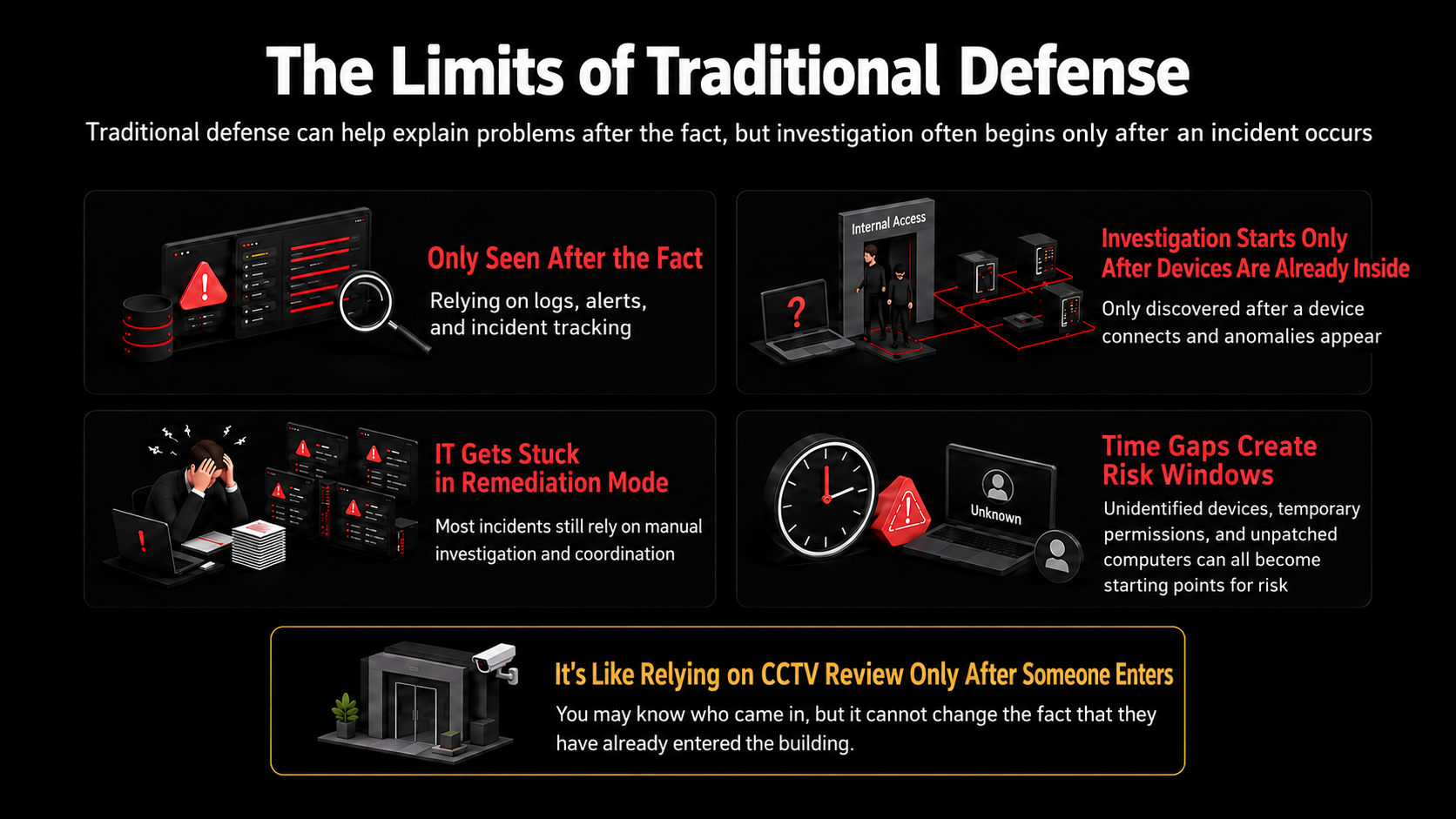
This is similar to building access management. Reviewing surveillance footage afterward can show who entered, but it cannot change the fact that the person was already inside the building. Cybersecurity works the same way. Logs and analysis can help enterprises understand a problem, but without controls at the point of access, IT teams remain stuck in remediation mode.
Traditional defense therefore remains an important foundation for enterprise cybersecurity, but it should not be the entirety of the first line of defense. A more mature approach to internal network security retains logging and analytical capabilities while moving critical identification and control earlier in the process, enabling enterprises to assess and respond as soon as risk emerges.
3. The Core of Proactive Defense: Move the Line of Defense to the Moment Devices Connect and Anomalies Occur
The core of proactive defense is not the use of more complex technology. It comes down to a direct question: Can the enterprise identify, assess, and address a problem before it expands?
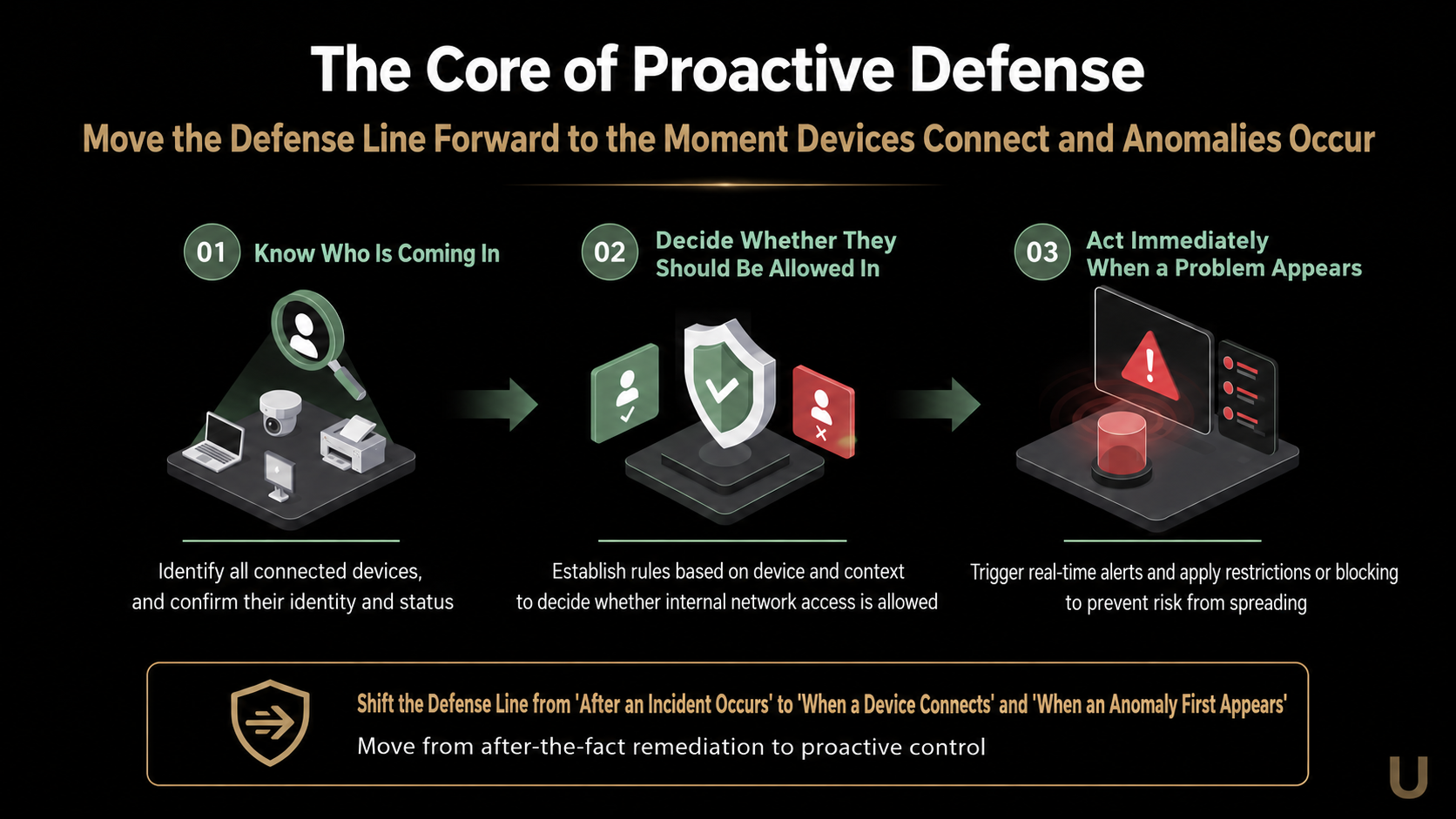
For internal network security, the first step is knowing what is connecting. Enterprises must be able to identify the devices currently connected to the network and determine whether each device is known and falls within the permitted scope. Without a clear understanding of the device itself, any subsequent discussion of access, remediation, alerts, or blocking lacks a reliable foundation.
The second step is determining whether the device should be allowed to connect. Not every device capable of connecting should be permitted to access the enterprise network. Employee laptops, guest devices, contractors' equipment, printers, cameras, and legacy systems should be governed by rules appropriate to their respective use cases, instead of being assessed only after anomalous activity is detected.
The third step is taking action as soon as a problem appears. When an unknown or unauthorized device, or a connection that violates policy, is detected, the system should generate an alert and restrict access according to enterprise settings. When necessary, it should block the connection to prevent risk from spreading further across the internal network.
Proactive defense moves the line of defense from “after an incident occurs” to “when a device connects” and “when an anomaly first appears.” In the past, enterprises often waited until after the fact to ask: Who owns this device? Is it authorized? A better approach is to make that determination as the device enters the internal network. If its identity is unclear or it does not comply with policy, the system should immediately issue an alert, restrict access, or block the connection.
This shift moves cybersecurity management from identifying problems after the fact to applying controls earlier in the process. For IT teams, it reduces the burden of repeated verification and remediation, freeing staff from constant investigation and cross-departmental follow-up so they can focus on process improvement, policy refinement, and long-term governance.
4. UPAS's Approach to Proactive Defense: From Visibility to Containing the Spread, with NAC as a Key Starting Point
For UPAS, proactive defense involves more than discovering which devices are present on the internal network. It begins with device identity, connection status, and policy compliance to establish an internal network governance process that continuously assesses devices and applies policy-based controls. When traditional security tools operate independently, IT teams often see only fragmented alerts and struggle to determine whether a device is compliant, poses a risk, or still meets the conditions for access.
Network Access Control (NAC) is a key starting point for UPAS to implement proactive defense.
UPAS uses agentless NAC to discover and identify devices as they connect to the internal network, capturing their IP and MAC addresses, device types, and connection status to give enterprises a clear view of connected devices. This allows enterprises to identify and assess printers, cameras, guest devices, contractors' laptops, IoT devices, OT equipment, and other endpoints that are not suitable for agent installation without waiting until a problem occurs to investigate.
Once devices are visible, UPAS helps enterprises turn device identification into actionable controls. Enterprises can establish allowlists and access policies, generate alerts for unknown or unauthorized devices, IP or MAC anomalies, and other violations of access policies, and then restrict or block access according to predefined rules. Internal network management can therefore move beyond reviewing records after the fact to applying real-time controls at the moment a device connects.
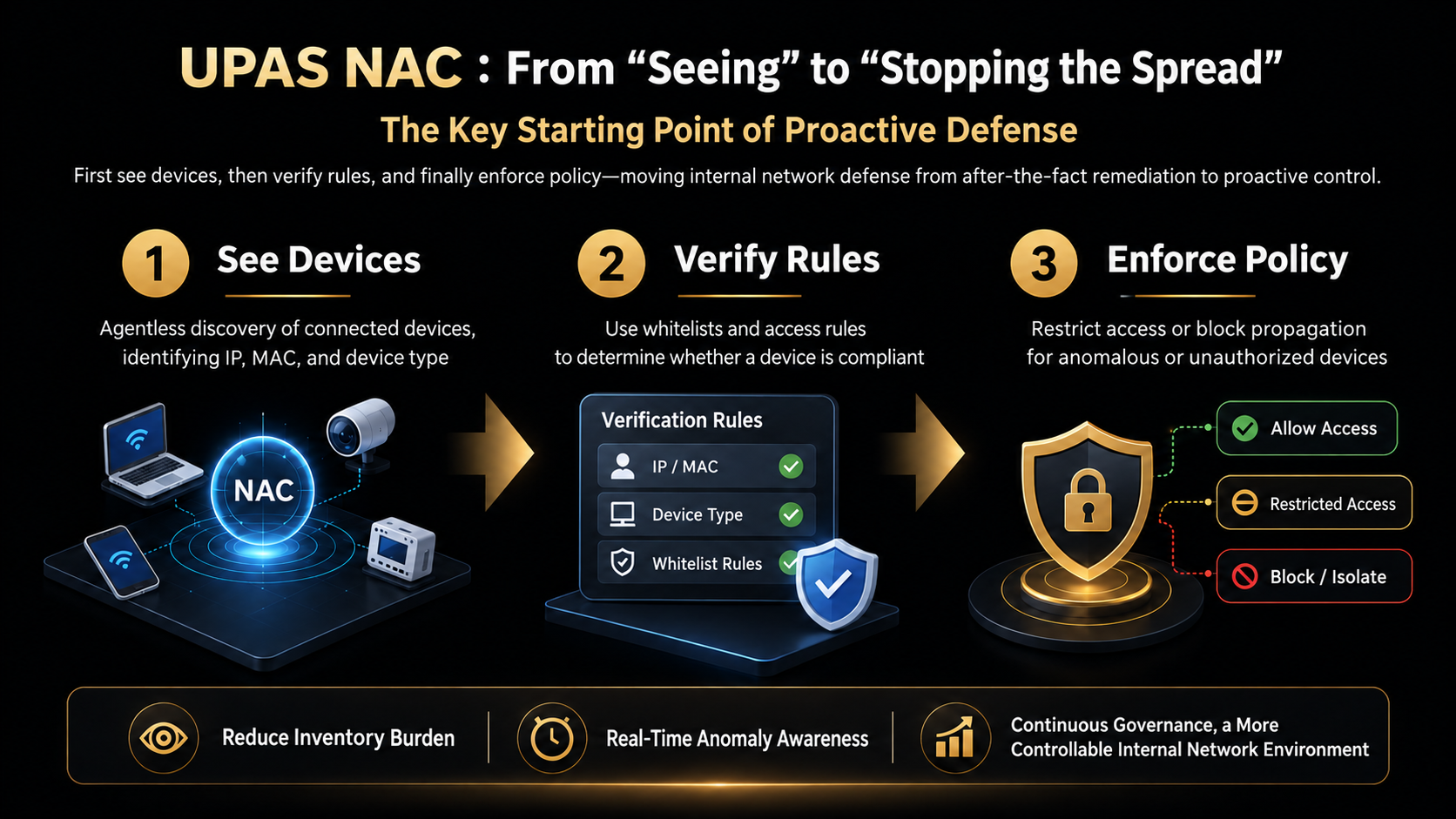
The value of UPAS's proactive defense approach extends beyond reducing the burden of manual inventory. It helps enterprises establish a dynamic risk-control mechanism. When a device's status changes, connection conditions are not met, or an unknown or noncompliant device appears, the system helps IT teams assess the situation and take action more quickly. This allows potential threats to be stopped at the source and gives IT teams greater control over cybersecurity operations.
5. Conclusion: Easing the Burden on IT Teams Requires Earlier Control, Not More Alerts
Cybersecurity defense is entering a new era. Enterprises have traditionally investigated logs, compiled reports, and updated rules after an incident occurs. These tasks remain important, but as the number of devices and temporary connections on internal networks continues to grow, defensive capabilities must move earlier in the process—from understanding problems after the fact to assessing and controlling them in advance.
What truly reduces the burden on IT teams is not another set of alerts that requires manual review, but the ability to identify a device and determine whether it complies with policy as soon as it connects, then issue an alert, restrict access, or block the connection when a violation or anomaly occurs. Enterprises need to know what a device is and whether it meets policy requirements at the moment it connects, and they must be able to issue an alert, restrict access, or block the connection according to policy when a violation or anomaly occurs. This keeps IT staff from remaining permanently in a reactive position.
For UPAS, proactive defense means helping enterprises connect device visibility, authorization decisions, access control, and anomaly response into a more complete internal network security process. When enterprises can act before risk expands, internal network defense moves beyond post-incident investigation and becomes an earlier, more stable cybersecurity governance capability that is better aligned with day-to-day operations.
Professional Consultation: https://www.upas-corp.com/request
Request an Enterprise Trial: https://www.upas-corp.com/apply
UPAS FACEBOOK ► https://www.facebook.com/upastaiwan
UPAS Official Website ► https://www.upas-corp.com
