


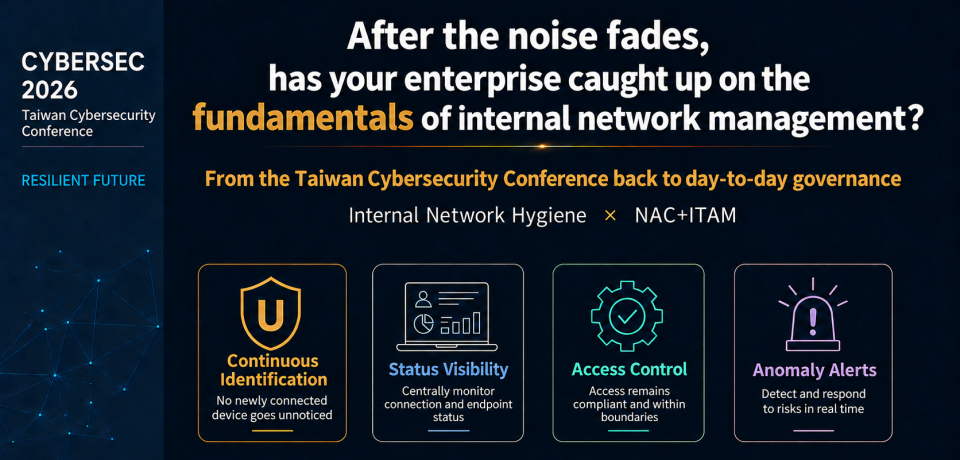
1. After CYBERSEC Ends, Enterprises Are Left with an Even Longer Management Checklist
CYBERSEC 2026 was held from May 5 to 7 at Taipei Nangang Exhibition Center, Hall 2. Centered on “RESILIENT FUTURE,” the event brought together more than 400 cybersecurity brands from Taiwan and abroad. From AI defense, Zero Trust, and cloud security to the identification and protection of the many connected devices within enterprises, the exhibition floor presented a comprehensive view of the current direction of the cybersecurity market.
However, the more new technologies appear on the exhibition floor, the more an enterprise’s ability to actually put those technologies to use depends on whether it can maintain visibility into devices, identities, access rights, and security status within its environment. As new devices and systems continue to be introduced, suppliers and contractors enter the network for maintenance, and existing devices may be moved or reassigned to different departments, both the number of objects that must be managed and the complexity of day-to-day management increase accordingly.
AI and automation tools can improve the efficiency of analyzing large volumes of signals, but they still cannot replace one foundational task: an enterprise must first know which device a signal came from, which department currently manages that device, and whether the network access complies with the permissions and policies originally approved.
In other words, tools can accelerate analysis, but what enterprises truly need to maintain is a continuously updated management foundation that reflects the actual environment.
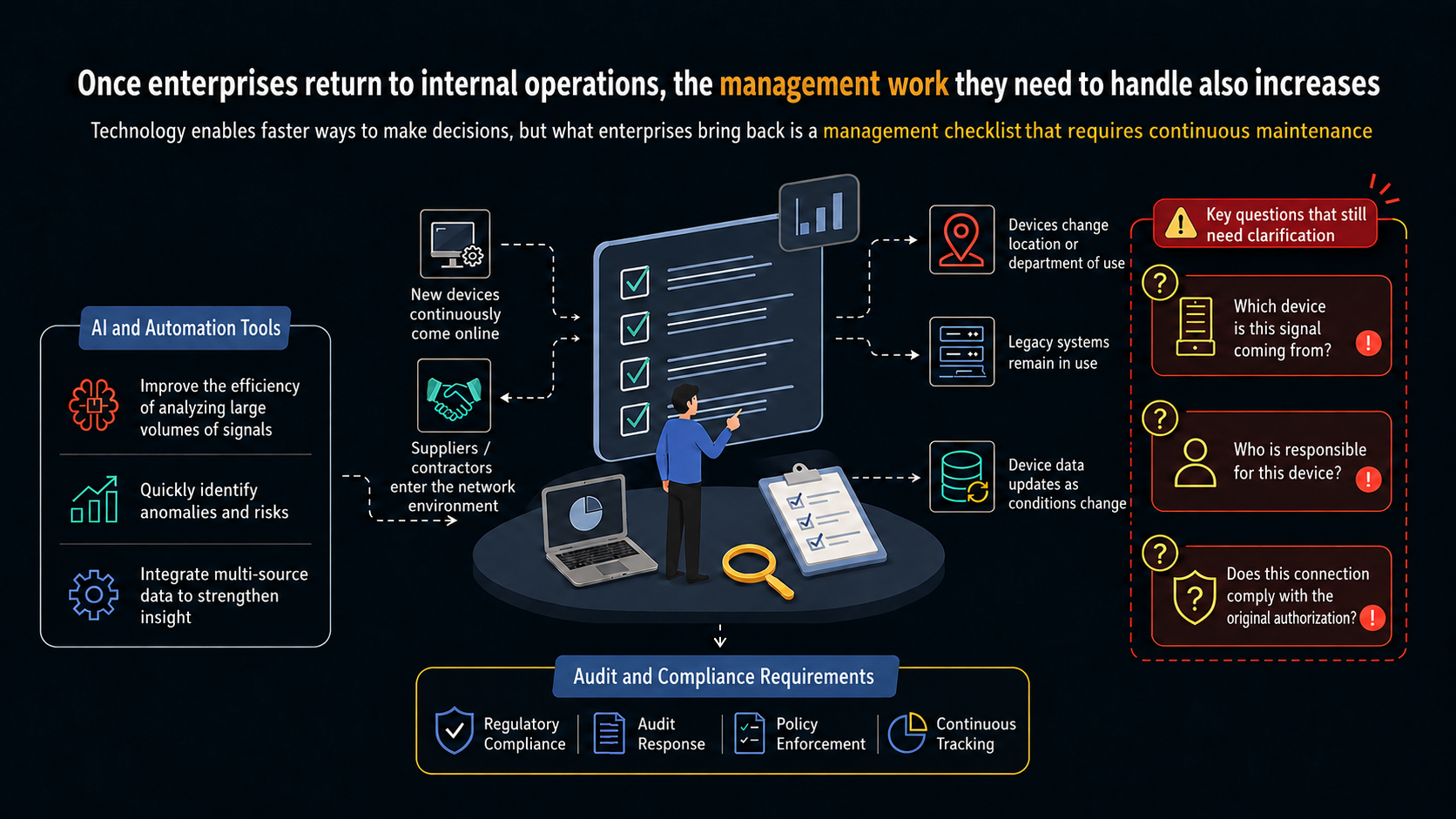
Technology enables faster decision-making, but enterprises still need to know which device a signal comes from, which department owns the device and who is responsible for managing it, and whether the network access is consistent with the original authorization. (AI-generated conceptual illustration; not an actual product interface or customer data.)
2. Taiwan Enterprise Reality: More Diverse Devices, More Fragmented Information and Management Responsibilities
Enterprise internal networks in Taiwan have long extended beyond employee computers and servers. In manufacturing environments, production-line controllers, industrial PCs, cameras, access-control systems, and sensors remain connected over long periods; medical and laboratory environments may include instruments, IoMT devices, shared workstations, and systems that cannot be freely taken offline. General office environments also include printers, meeting-room equipment, visitor devices, and contractors’ laptops.
The growing variety of devices is only the surface issue; the more difficult problem is fragmented information.
A procurement system may record which devices the company purchased, but not whether those devices are still online. Network administrators can see IP and MAC addresses, but may not know a device’s actual purpose or responsible department. The department that owns a device may know its purpose and users, while the cybersecurity team may not know whether the device has been patched or meets security requirements. After a supplier completes maintenance work, temporary connections and exception-based access rights may also remain in place instead of being revoked.
These gaps may not cause an immediate failure during normal operations, but they can significantly increase management costs when an incident occurs. IT personnel may need to compare data across systems and contact departments one by one before they can determine who owns a device, why it is connected, and which department should handle it. When departments maintain inconsistent device information, vulnerability remediation, access-control settings, incident investigations, and audit work often rely on different lists, increasing the likelihood that some devices are missed during patching, access rights are not revoked, investigations are delayed, or audit records do not match the actual environment.
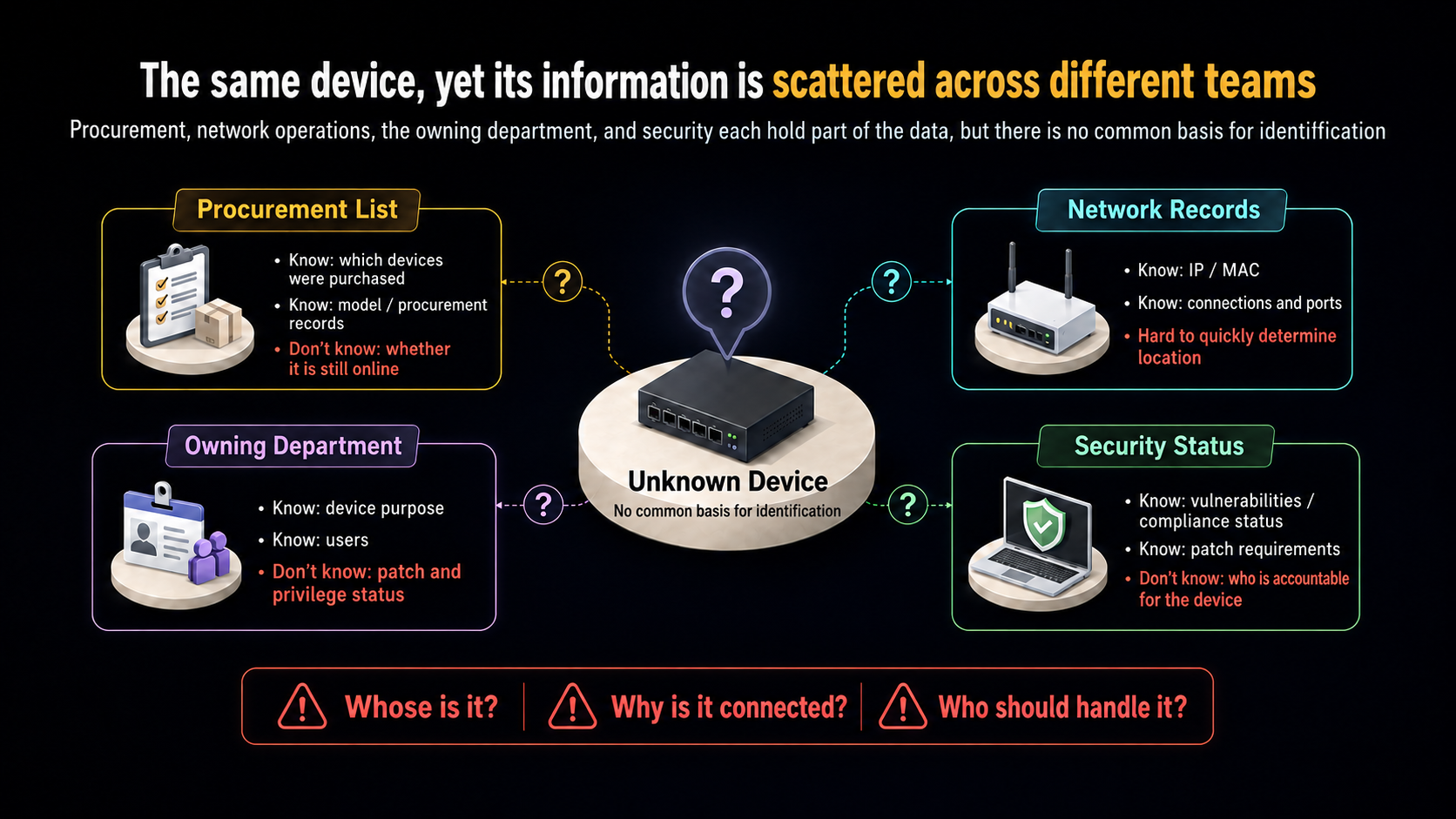
Fragmented device information and misaligned management responsibilities often prevent enterprises from addressing problems promptly and effectively. (AI-generated conceptual illustration; not an actual product interface or customer data.)
3. From Asset Inventory to Internal Network Cyber Hygiene: Putting Cybersecurity into Practice Starts with Continuous Management
As device types increase and related information becomes scattered across different systems and departments, enterprises need to move beyond one-time asset inventories and establish an internal-network management mechanism that can be continuously updated. This kind of ongoing foundational management is often grouped under Cyber Hygiene. When the focus is the enterprise internal network, it can also be understood as the day-to-day “public hygiene” of the internal-network environment.
Internal network cyber hygiene can be understood as the day-to-day work required to maintain order within an enterprise network. This includes continuously discovering newly connected devices, clarifying device identity, department ownership, and management responsibility, managing connection permissions, and checking the software, patches, and security status of managed computers. When unknown, unauthorized, or noncompliant devices appear, there must also be clear alerting and response procedures.
Cyber Hygiene is becoming increasingly important because enterprise internal networks are constantly changing. Discussions at CYBERSEC 2026 around system continuity, hardware security, and enterprise governance also highlighted the value of this foundational work. If an enterprise wants to maintain critical services during an attack or disruption and accelerate subsequent recovery, it must routinely know which devices are connected, who is responsible for them, whether they are authorized, and whether they currently meet cybersecurity requirements. Some devices cannot have an Agent installed, and a device’s location, purpose, or responsible department may also change as operational needs evolve. Relying only on annual inventories or manually updated spreadsheets makes it difficult to reflect the actual environment over time.

UPAS showcased solutions related to internal-network security management at CYBERSEC 2026.
The real challenge of internal network cyber hygiene is keeping device information, actual network connectivity, security status, and responsibility ownership continuously aligned. To make this part of day-to-day management, enterprises need a mechanism that can continuously discover devices, validate and manage network access according to established policies, and simultaneously maintain visibility into asset and security status. This is precisely the core problem that UPAS NAC + ITAM is designed to address.
4. From “Having a List” to “Continuous Management”: UPAS NAC + ITAM Closes Management Gaps
To make internal network cyber hygiene part of daily operations, enterprises need to maintain visibility into two types of information at the same time: which devices are currently using the network, and what condition those devices are in. The former concerns device identification and network access; the latter covers asset, patch, and compliance management.
UPAS integrates Network Access Control (NAC) and IT Asset Management (ITAM) on the same platform to close information gaps within the enterprise:
① NAC Network Access Control
When a device enters the internal network, UPAS NAC can use Agentless technology for device discovery and identification, capturing IP, MAC, device type, and connection information to help administrators identify unknown or unapproved devices. Enterprises can establish device allowlists and network admission rules based on their own policies, generate alerts for IP/MAC anomalies, unauthorized devices, or other events that violate allowlist or admission policies, and control or restrict network access according to predefined policies. When used together with guest-management capabilities, access scope and validity periods can also be defined for contractors and temporary devices, reducing the risk that exceptional access rights remain active after they are no longer needed.
This capability closes two common gaps: “the device is on the list, but we do not know whether it is currently connected,” and “a device has appeared on the network, but we do not know whether it has been authorized.”
② ITAM Asset Management
When management needs extend from connectivity to device status, UPAS can deploy an Agent on managed endpoints and use ITAM-related modules to collect information on software, operating systems, Windows patches, antivirus protection, and compliance. By comparing devices against a vulnerability database and using patch-management mechanisms, the platform can further perform update checks, vulnerability correlation, and patching, helping enterprises identify the devices that need to be addressed first.
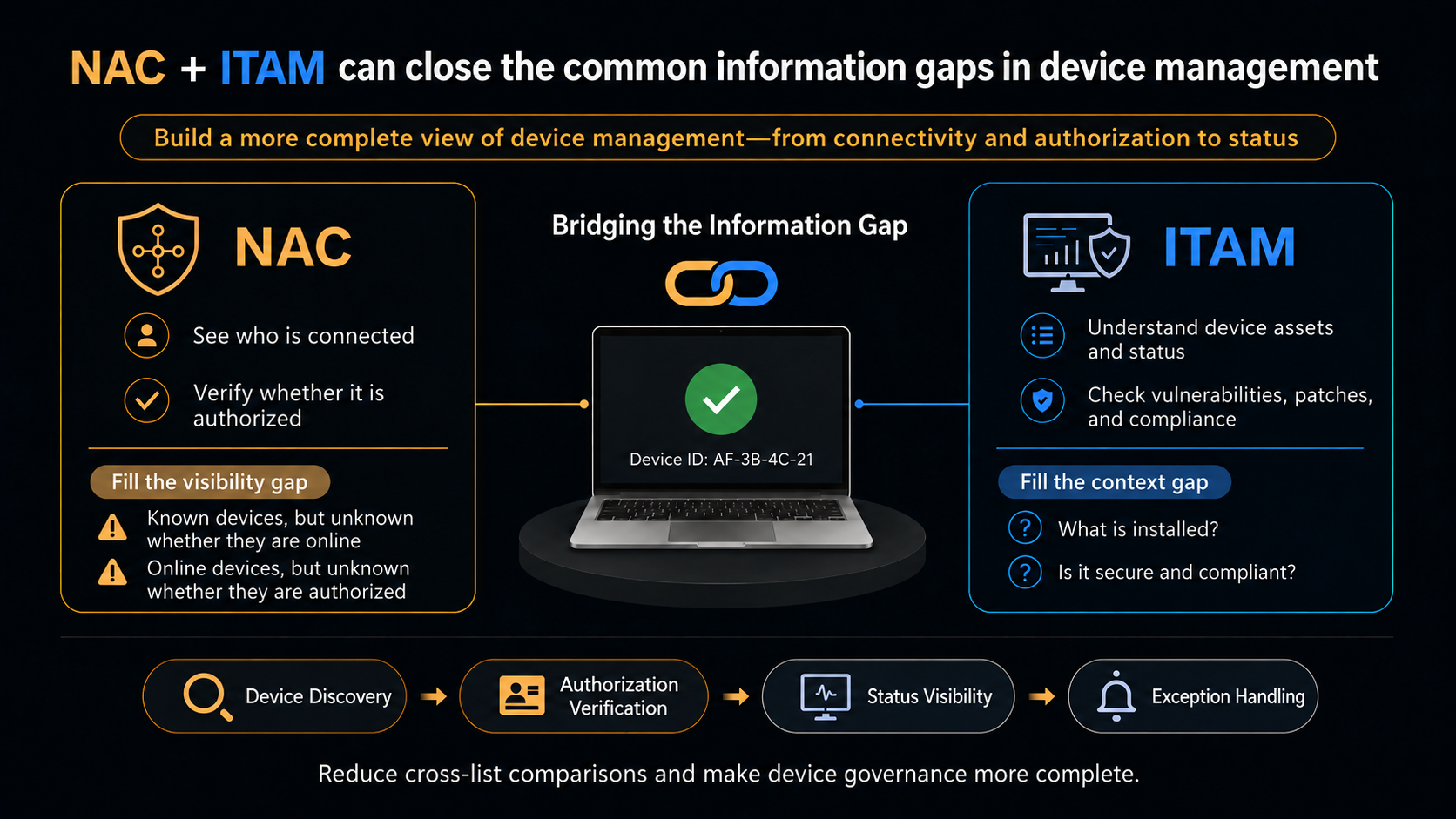
NAC + ITAM can close common information gaps in device management. (AI-generated conceptual illustration; not an actual product interface or customer data.)
When NAC and ITAM capabilities are integrated on the same management platform, administrators can review the network connection, authorization status, and available asset and security information for the same device. This reduces repeated cross-checking between different systems and lists, and makes device discovery, access management, status checks, and anomaly handling a more continuous day-to-day management process.
5. Cybersecurity Technology Keeps Evolving, but the Fundamentals Still Determine Whether Governance Can Be Put into Practice
Every year, CYBERSEC introduces new technologies and new approaches to defense, while enterprise internal-network environments continue to change as well. New devices are added, employees and suppliers come and go, software and patch status are updated, and existing access rules are adjusted as operational requirements change.
In an environment like this, the fundamentals of internal-network management cannot be completed through a one-time inventory or a concentrated cleanup before an audit. Enterprises need to continuously discover devices, clarify responsibility, validate access rights, maintain visibility into device status, and take action according to established policies when anomalies occur. These tasks may look routine, but they directly determine whether cybersecurity policies can actually be enforced and also affect how quickly an enterprise can understand the situation when an incident occurs.

UPAS showcased solutions related to internal-network device identification, access management, and asset management at CYBERSEC 2026.
For UPAS, the value of participating in CYBERSEC lies in continuously understanding, through real questions raised by local enterprises, the gaps among device inventory, network access, compliance, and cross-department operations and maintenance. Through NAC + ITAM, UPAS helps enterprises bring fragmented connectivity and asset information back onto a consistent management foundation, turning internal network cyber hygiene from a concept into day-to-day practice and establishing a stronger starting point for subsequent cybersecurity defense and operational resilience.
Professional Consultation: https://www.upas-corp.com/request
Request an Enterprise Trial: https://www.upas-corp.com/apply
UPAS FACEBOOK ► https://www.facebook.com/upastaiwan
UPAS Official Website ► https://www.upas-corp.com
